It's hard to believe that it's the last week of my first semester of graduate school. I know it's been a while since I last updated. I came to realize as the semester went on that part of what makes my program work is that everything is a surprise. The faculty work very diligently to lead the class into each lesson seamlessly without giving anything away in advance. It creates an atmosphere of discovery and adventure. By openly blogging about our creation prompts and lessons I felt like I could potentially reveal too much to others that might venture to take this program.
So I'm working out how best to record my adventures without perhaps giving too much away. I'd love to do a recap for myself though! This first semester starts with nature. We begin our exploration of the physical body through the neutral mask. This is a Lecoq technique with actual leather masks. It has a lot of similarities with Alexander technique. Finding a neutral stance, and learning your bad habits so you can put less stress on your body. By finding neutral it becomes more apparent when the performer makes a conscious choice to change their physicality, and that's the basis for good character work.
We took our neutral mask through nature. Starting in the ocean, landing on the shore, seeing the edge of a forest, entering the forest, traversing through the forest over obstacles, exiting the forest to reach a field, seeing a mountain, climbing the mountain, peaking and seeing over the edge, coming down the mountain (in various forms), coming to a river, crossing the river, entering tall grass, finding a desert, watching the sun set and the stars come out, then exiting. A long journey! The greatest lesson in the neutral mask through this journey is how to see. When you, as the performer, see what is ahead you allow the audience to see. This is the basis for everything we covered this semester. How does a performer create space. By making sure the mask (aka your face because eventually the mask comes off) faces out, and taking the time to make the gaze specific to the coming space, a performer can create the world before it is entered into. The eyes must always be out and seen.
Throughout this process the faculty was determined that we would be as specific and realistic as possible. We took a trip to the ocean and practiced turning around and seeing it for the first time. Where was your eye drawn? How did your breath change? What was the measure of time it took to see it all? We also practiced entering and exiting water of different heights. Dry sand to wet sand to shallow water to current catching to waist deep and then shoulders deep. How does the tide move your body? There was so much specificity to be learned. When we returned to the classroom it was our job to create this same physicality without set or props. Gaze, breath, and physicality. We practiced by breaking the process into steps. Walking on sand, the grabbing of the toes, and then an incremental walk into the water and the difference in weight distribution.
When we'd moved on from the original journey of the neutral mask we took it on different adventures. We did the same journey but called 'Cataclysms' where in each step something big changes the landscape. There was a hurricane in the ocean, a fire in the forest, an avalanche of rocks on the mountain, a volcanic explosion when you reached the top that carried you off, rapids in the river, a tornado in the grass, and a sandstorm in the dessert. How does the physicality change? And how do you keep your face completely neutral through these when not wearing the neutral mask? That was definitely the hardest part. The mask is always neutral, and it teaches you that even after it is gone, your mask should remain neutral too. The facial neutrality allows an audience to stop focusing on that area of the body for clues to how they should respond. Instead it redirects focus to the rest of the body and allows the whole to tell a story. So whenever you're traveling through the cataclysms you have to show a a change in space with your body, but not your face.
Another difficult skill to master is that the story is told by traversing space. It doesn't need to be a struggle. It can be very indulgent and uninteresting to watch a body struggle though space. Climbing the mountain even in an avalanche need not be difficult, because the neutral mask can only move forward. There is no thinking that needs to happen. You can search for the next foothold, but you can only do so if you can do it un-intellectually. Fun, right? The other challenge was how to recycle space. These journeys have to feel like they're outside of the room you're performing in, and performances often happen in small enclosed spaces. So without a proscenium to help you, how can you continue to cross the same space but make it look different every time?
We incorporate the neutral mask in everything. From there we traveled through different bodies of water. Water seeping from rocks inside a cave, sweating until dripping, then the drips trickle into a creek which becomes a stream which became a river. The river then had a dam which led to a waterfall which led to a larger river with rushing rapids that eventually led to the ocean. In these exercises we put our bodies in the space not as if we ourselves were in the water--but as if we were water itself. We tackled the elements. We became fire in all its different forms (ash, smoke, spark, burning), and air (hurricane/tornado force, gentle breeze, kite flying weather), and earth (mud, dirt, trees). In each of these forms we started with the breath of the element, and then the gaze. We found the physicality from these and as we physically became them we allowed our breath to create the voice we would use and then improvised language.
This spawned one of my personal favorite creations this semester (spoiler alert: the awkward party). My group decided to be 12 year olds having their first boy girl party and all the awkwardness that comes with greeting parents, being alone in a room with no chaperone, and playing a game of twister. It was fascinating creating scenes where elements inspired characters, but we used those elements to show our interactions. So air can stoke a fire to be bigger, fire can burn earth or earth can put out a fire. Water can put out a fire, or fire can boil water. So many choices! Suffice to say that everyone thought our party was incredibly awkward once all the elements ended up close together on a twister mat. I should mention this was at the same time that we were practicing 'clocking' in Jeu (Play). Clocking is when a performer turns their mask (face) out to the audience. So you're performing an action as if it's normal and then you face forward. This reads as a comment on the action. The comment is up to the performer. We ended our party with all of us in awkward positions on the mat and then turning to clock the audience, allowing them to feel part of it.
Jeu was a class that took me awhile to get the hang of (actually I'm not sure I ever did get the hang of it), but once I got going it was incredibly freeing. This class allowed us to explore body physicality through games. A lot of class we would put two people in the middle and they would start doing abstract movements until a game was established (even if the game was something as silly as I touch your foot and then you touch mine, or as intricate as basketball) and then once the audience could say what the game was the performers would abstract it again until a new game was formed. In this game the challenge was to try not to necessarily play a real game, and to try and create a relationship with your partner where no one person was leading. So it couldn't be a switch off between who would create the next game. Through breath and listening and repetition of movements the duo would decide simultaneously that they had the next game. Difficult to master but easier the more you do it!
We also played structured games. We played serious games of imaginary tennis with the only goal being to match what your partner was doing so you were playing at the same level. We played a game where you and your partner had to keep the same amount of space between you. So if one person moved forward the other had to move back, same with side to side motion. And if there was a mistake made that changed the space then you had to agree on the new space between you and play that game instead. We played a game where you had to create an object with your hands in space, play with that object until the audience could name it, pass that exact object to another person in the circle who played with it in the same way, and then they had to reshape that object into something else and do the same thing.
All of these games require you to not think. Thinking is the death of play. We played a game of who could die bigger. The weapons would change, but one person would be killed by another, then come back to life and kill the person who killed them, who would come back to life and it would go in a circle endlessly until it felt like the death was as big as it could possibly be. This class was sometimes difficult in the beginning because each time a new pair started a new game it felt as if the rules changed. I soon realized that the point of the class was that there was no rules at all and that doing something as big as possible was really the name of every game. Take risks, fail big, don't think.
This all feeds into our improvisation classes. In improv we often practice our next step of the neutral mask. We went from elements to colors to paintings to pictures to music and we're finishing the semester with animals. Improv is our opportunity to explore the physicality of these and discover how to perform them with a universal language. How can I be the color blue and have the audience know I'm the color blue? What is the dynamic of the color blue? The rhythm? The breath? How long does it last? What shade is it? A class like Jeu can really free up your body to tackle these questions. I once worked for one week trying to be a picture of a multicolor carpet in a Vegas casino. The script I wrote for this said, "Wa wa waaaa wow wowee woah winding willowy watermelon wildebeasts Welcome!" And that was normal.
In movement analysis we worked on different 'attitudes'. These are movements working with fixed point. Creating a stick in space, grabbing it, shifting it from horizontal to vertical, and back again. How do you release in a way that the audience believes you don't still have it? Can you leave it in space with your gaze even if your hand isn't touching it? Of course to get there we practiced throwing around real sticks a lot. Can you throw and catch silently? How do you cushion a blow? We moved imaginary tables and set them. We learned to juggle and do plate tricks. We became different forms of light (starlight, moonlight, sunlight, sun through trees) and then said Shakespeare with our movements. We practiced seeing and climbing walls. We became different materials with our bodies. How does honey leave a jar? How does it land on a new surface? Can your body become the consistency of honey even though you have bones and joints and fingers?
Mostly what we learned this semester is that having bones and joints and fingers and arms and legs makes being other things that aren't human very very difficult. But eventually in all of these explorations we dial back the material/color/element/picture and put the physicality in our bodies as human. Maybe you're 50/50. Or maybe you're 80% one and only 20% the other. Where does the human body take over? When does language become necessary?
I've really enjoyed leaving out language this semester. I thought it would be difficult since I've had a career in popular theatre. This means reciting a script first and physicality last. But this has been such an amazing experience to flip what I know on its head. When the physicality is focused on, it can inform the voice, and the words aren't necessary unless the body can't tell the story alone. And most of the time it feels like it can. I know we'll be adding words back in soon this next semester and that will be a challenge. A lot of times when we speak as these characters we create, it feels like we become a parody instead of embodying it wholly. Such a difficult balance!
Throughout all this we also had our marvelous voice class. We learned different resonators (chest, nasal, mouth) and worked on placement. We've practiced mimicking sound because once your learn placement for yourself it's useful to know if you can recognize placement in someone else and copy it. In fact, this class is where I learn the most pedagogy. We spend so much time watching each of us individually discover whatever the vocal lesson is that by the end you know how to do it as much as you know when you hear it or see it. This means I can tell where someone is placing their voice. Which is really useful.
In our music skills class we're rounding out the semester by writing our own songs. I really didn't know if it was possible to come so far so fast. Our professor told us we'd be writing songs by the end of the class, but it seemed so far off. I actually really like the song I wrote, and I'm looking forward to second semester of music skills where all we'll do will be writing songs. It's hard, but it's such a great skill to have!
I have one final creation showing this week, an evaluation from my professors, and then I'm off for winter break. I plan to do a lot of strength building to stay strong for second semester acrobatics. This semester was somersaults, cartwheels, and handstands. Who knows what next semester holds?

Showing posts with label Women power. Show all posts
Showing posts with label Women power. Show all posts
Tuesday, December 4, 2018


Saturday, September 8, 2018
One Place, One Event
Each week we're split into groups, given a general prompt, and then we spend time each day as an ensemble creating a piece of theatre that corresponds to the prompt. The first week was 'Creation of the world' and this last week was 'One place, One event'. In my first group we began by each creating our own 'world' to play in and we played as a group until we found several ideas that resonated. Then we expanded those ideas through play until we found an arc with a beginning, middle, and end. It was such a new experience for me, basically performing improv until an idea forms instead of forming an idea and then trying to create it. But like all new things, it got better with practice.
You can ignore parts of this post that will get into details that won't matter to anyone but me. Remember this blog is also my actor journal for me to remember and describe lessons, so I'm sure some of this won't be interesting for the average reader.
Now on week two it was exciting going in with the prompt and knowing that I could confidently create something. Week one we worked with no voices or props. It was about creating pictures with your body and using sound with no words. My group formed shapes along the walls in the room while I knelt in the middle. They slowly peeled themselves off the wall and began to walk in a rhythmic circle around me, beginning a syncopated pounding heartbeat with their hands until they were running. They stopped as one, put their hands into the middle of the circle onto my back and began to breathe with my movements. I went up and down until I was 'born' from the middle of the circle with a gasp. On my gasp the breath was taken from each ensemble member until they all fell down. I revived them with my breath again, and we began to make relationships. We mimicked movements and mirrored each other. Then one member makes the first sound. We then discovered how to copy the sound. Then we discovered touch and then play. The touch became violent until one ensemble member was shoved to the ground by me. We discovered violence. This member was then encircled again as I had been in the beginning, but when they broke out of the breathing circle and stole the breath from us we weren't able to be revived. The last moment was the sound of loss.
Writing this in detail it sounds very artsy, but in action we created life, relationship, sound, touch, and then cycled to death. It felt very powerful to use body without words and I really enjoyed the experience because the story line was very specific. There were other creations that were made of vignettes, and somehow each creation piece at some point included all bodies standing in a circle and then falling down (just like ours). So strange! On creation day the faculty all sits in and then critiques. The general feedback on week one was to simplify, be specific, and follow the prompt. We learned how easy it is to get carried away. My group had positive feedback and we were really proud of the piece, but the consensus was that we created 'the world' in the first 1/3 of our piece, and the rest was a continuation. That's a good example of how we could have simplified the piece. They also commented how each group had mostly depicted a human experience and that we had forgotten other elements.
So for week two my group took the general feedback to heart. We wanted to play with nature this time. In movement and improv classes this week we practiced this exercise of creating a place. My cohort created a park and we spent several class periods being characters in a park and learned to expand the room so it felt like there weren't walls, control voices so they felt the way they would outside, and focused on not stealing focus. We wanted to incorporate these lessons into our creation project so we picked the ocean as our place, and the event was the rising of the tide on a beach. It took a few days to solidify the best way to create waves with our bodies (and I have the bruises to prove it), but we finally picked four of us to stagger in a pattern on the floor with our bodies lying down straight like a log. We wanted to play with perspective so we began as if the audience was looking at the ocean horizon. We rocked slowly and made soft ocean noises. Then the rocking turned into rolling forward towards the audience with the sounds of waves crashing on the shore. At this point one of our ensemble entered as a child to build a sandcastle. Our rolling waves became bigger until we brought them to shore. Two of us became sea foam using our arms to replicate the tide dragging sand backwards, while two in the back became the crest of waves. We attempted to crescendo the sound as we got closer to shore, and built the tension towards the object of ruining the child's sandcastle until it had been completely swallowed by the ocean and the child ran off.
The other ensembles created a tree that was cut down, a cave where someone found gold, and the world before a volcanic eruption. Their feedback was that the place wasn't specific enough, and that the even took too long to happen or that there were multiple events and it was unclear. Overall the faculty seemed really intrigued by our piece, and said that the place was very clear. However, they as an audience had an expectation that there was danger to the child and that the event would in fact be more ominous. Professor Q said there are two types of theatre. One is when the actors know more than the audience and the audience has to figure out the story and catch up to the actors. The other is when the audience knows something the actors don't and the actor has to figure it out. If we were to do this piece again they wanted an exploration of what it feels like for the audience to know more about something than the actor. They wanted the beautiful moment of when our child would discover the danger they were in the same way the audience felt they were in danger. I found that so interesting! And something that hadn't occurred to me. We were attempting to simplify our event, so I hadn't considered something so big as drowning a child. But they said that our place was so big that the event ruined our crescendo. It was a let down. We needed to match the beginning with the end. It definitely made me want to explore the piece further. But I'm also excited to not roll around on my bruises anymore.
In other news this week we saw our first fringe show at the Philadelphia Fringe Festival. It was called The Accountant and I'm sure I'll write more about it later. It had some spectacular special effects and a stunning sound design.
In movement analysis this week we worked on Lecoq's Seven Levels of Tension. This is one of numerous acting techniques and something that was fun to add to my repertoire. My graduate school faculty studied (for the most part) at The Lecoq School of Physical Theatre in Paris, so we'll be using a lot of these methods throughout my time here.
Levels:
1. Tired, lethargy, exhaustion
2. California, Cowboy, laid back
3. Efficiency, Neutral
4. Alert
5. Suspense
6. Passion
7. Hypertension, Tragic
We embodied each of these in class over the week, sometimes creating stories as an ensemble or in small groups. I'm excited to play with these more.
Our music theory class this week (our longest class at three hours) was a lot of work! We worked on scales, which I'm grateful I already know, finger placement on piano, rhythm, and solfeggio. We'll be performing the C scale and our own written melodies next class.
In voice class we're working on diaphragmatic breathing exercises and using sound on breath. I'm also finishing up reading Artaud's The Theatre and Its Double for seminar this Monday. I'm excited for this seminar class especially because we'll really be focusing on the history of physical theatre and the companies that have done and currently do it.
I've got a busy weekend ahead of me. Another fringe show to see, and several assignments to complete!
Wednesday, August 29, 2018
A Flying Leap
My class is apparently the largest class since my MFA program was created. There are 19 of us total, and every single class we have to reintroduce ourselves to our new professors. It's amusing to watch them attempt to remember our names, but I admit that I can't wait until we don't have to play name games or stand in a circle and introduce ourselves anymore. We're in such a routine with it now as a cohort because we've done it so much. I believe we have one more instructor we haven't met. Thank goodness!
So I titled today's post based on an exercise we did in improv yesterday. 18 of us stood in two diagonal lines two feet apart and held our arms out in a zipper fashion so everyone was forming a cradle. Then one person ran from across the room and took a flying leap into our arms and attempted to jump far enough that they could reach the arms of those cradling on the far end. I was terrified because our arms were just held out on our own strength, not reinforced in anyway by the people across from or beside us. When it was my turn to stand in the front and catch it was really difficult to catch people because there was so much weight and momentum! And it was terrifying. But not as terrifying as leaping. I took a turn and the first time I went I shot like a bullet straight at the arms instead of lifting myself higher into the air. Professor Q gave me another shot. One of the things I've been enjoying most is when I take a turn in any class it gets analyzed and then usually there's direct feedback and the opportunity to try again. The next time I jumped too soon, but definitely made it all the way into the arms. I was given a third try and this time managed to springboard at the right moment and flew into my cohorts' arms. It was exhilarating! Writing this I can still feel the adrenaline. I was proud of myself for volunteering even though I wasn't sure I'd do it well. The fear of failure is something I told myself I wouldn't allow into my training for the next 2.5 years.
I received some really great advice my first time meeting some of the upperclassmen. I was told that since my class is so large I should take every opportunity available to have a turn in class. They said that there wouldn't always be enough time to have everyone take a turn, and it's up to me to make the most of my investment and really put myself out there. The lessons aren't repeated so if you don't take your turn, you miss an opportunity to practice instead of watch. They said even if I felt guilty to always be the volunteer to never give up my chance to participate.
I really took that advice to heart and I've volunteered in every class so far. It's true, there hasn't been enough time for everyone to have the chance to participate. It's felt really great to get up and play instead of being a bystander! And even when I wasn't sure I wanted a turn, I made sure I took one.
In addition to improv, I took my first acrobatics class. This semester we're focusing on handstands. That might sound simple to some of you but I've never been able to do one without a wall. I'm really excited to build up the strength to be able to do a handstand. We played a lot of awesome movement games and activities really awakening to our space and bodies. We also formed ensembles and did an exercise where one person in the middle of a circle was straight as a pencil and allowed the group to tip and push and pull their body in every direction, giving complete control of their balance and weight up. It was a good core strengthener and trust builder. I can tell I'm going to love this class and can't wait to focus on my physicality! I know I've allowed myself to get our of shape and there's so much I want to accomplish in this class that I can't wait to get to the fitness level to do it. I'm feeling very motivated!
I had my first class of Jeu (which means Play) yesterday as well. This is a class where we just...play. We didn't use words. We just walked in and started doing whatever we felt like until we were all playing one game, which yesterday just consisted of a lot of people dying. Eventually I think it will become a more guided class with prompts, but it was great to let go for an hour.
I also had my first voice lesson and I can tell I'm going to learn a lot this semester. It will be great to be taking private voice at the same time that I have a music theory class. On Wednesdays we have music theory for three hours. We'll be learning piano, music progression, ear training, intervals, composition, and a bunch of other things I can't remember. I'm really excited to get back into the music side of performance in a way that doesn't necessarily include musical theatre. I know I'll be getting training in that as well, but just having the opportunity to work on composing, sight reading, and ear training is going to be so useful in the future.
I see graduate school as the place that will help me fill in all the gaps I've discovered in my professional training. So far my MFA is proving to do just that. I'm so excited to focus on these holes and have the time and guidance to fill them. I'll be learning new skills every day, letting go of old habits, and strengthening myself in mind and body.
Today in Improv with Professor M we did an exercise where someone had to volunteer to stand in front of the class with us as the audience and just do nothing. Breathe, be present, be aware, make eye contact but do nothing. For some reason this was something I excelled at today. When trying to puzzle out why I felt ease when performing this task compared to some of my cohort I realized that it was because I feel very strongly that I belong. I feel comfortable and excited and ready. I mean, there was the part where I had to act like a giant ogre before I settled into breathing with depth and a neutral mask, but that was only to be expected, right?
I can definitely say I'm sore from these last few days. I have blisters and bruises and muscles that feel like jelly. Luckily my Movement Analysis class with Professor S was a great class to stretch and settle into the sore places. Today we focused on walking as different characters. How long does it take for your arms to move? Are they out of sync with your legs? What part of your body do you lead with? Professor S notices so many intricacies and loves to point them out and create characters of her own out of them. I can tell every lesson in that class is going to be very enlightening.
My creation piece from this week is coming together nicely and I'm learning a lot from the process. We were given the prompt 'Create the world'. We split ourselves into three groups on Monday and on Friday we'll perform our devised pieces in ensemble. Instead of talking about the prompt my group got on their feet and we each took a turn creating a space and leading the group in play to 'create a world'. Then we played further with the most coherent ideas that struck our fancies, and now we're almost finished composing. It's interesting to be at the point where in a normal show you'd worry about specificity. In devising it's more allowable to say that the chaos and messiness is almost the point and that the specificity could potentially take away meaning. I'm interested to explore this concept throughout the program. I'm sure different ensembles will think of this differently, and when we're studying different subjects in our classes I think our thought process will change as well. Watching a non-narrative show this week definitely affected our outlook.
Tomorrow I will play some more! For now, I'm off to bed for a night of rest and strength rebuilding.
Wednesday, March 4, 2015
Sweet Briar College closing and Why Women's Colleges Matter
Subtitle: How has attending a women's college helped me?
This is so important. Women's colleges matter. Today, as much as throughout history, women's colleges matter.
Sweet Briar College is closing their doors.
Why is this important? Who cares? There are thousands of colleges and universities in America; what does one less mean?
Sweet Briar College is one of the few women's colleges left in the country. Wikipedia (forgive me for quoting wikipedia, but it was difficult to find a list) states there are approximately 48 women's colleges still functioning as women's only institutions of higher education. Other articles say there were as many as 230 in the last 50 years. Sweet Briar was founded in 1901, and has been challenging, accepting, and encouraging young women ever since. It has made many top ten lists. They are a small liberal arts school in Virginia with only 760 students enrolled in this academic year and every one of them is a woman who will lose a home.
This is important to me because I attended a women's college. I did, and so did hundreds of thousands of other women throughout history. At one time, of course, they were the only way for women to attend college. What's more, for every woman in America and beyond that is looking at colleges, I want women's college to be an option for them all.
I chose to attend Stephens College after a rigorous and thorough search across the country of the best fit for my formative young adult independent years. I never intended to go to a women's college. I had an older brother, and grew up playing with mostly boys. I had as many boy friends as girl friends, and I'd never considered the idea that I'd ever knowingly choose to spend a significant period of time away from my male counterparts.
I'd also never considered the lack of equality in my life, how hard I fought for success in comparison to men, or what it was to appreciate women and being a woman through the eyes of women only.
I worked exceptionally hard through high school, knowing that I wanted to leave my home state for college. I had a great GPA, a long list of extracurricular activities, and enough volunteer hours and awards to make almost any school I wanted look my way. This is true for many women. When I attended my state theatre festival and auditioned for over 50 schools I was surprised at how many showed an interest. But after a long day of meetings, and several weeks of visiting campuses and pouring over websites--there was only one place that felt like home. Stephens. It didn't hurt that their theatre program was ranked #2 in the country at the time.
I remember making excuses for the inevitable questions--Why are you going to a women's college? Why do those even exist anymore? There aren't any boys there? How will you find your husband? And of course--you're studying theatre?
I remember telling people that Stephens was ranked #2 in the country. That the class size was small and intimate. That I would get more one on one time with my professors. That they had accepted all my AP credits and I could skip a lot of required classes. That the campus was beautiful, and I could get to class within five minutes. I remember saying "Well there are boys in the theatre department, of course." They were considered apprentices and not students.
The worst part is looking back and realizing that I knew I was making excuses. I hadn't yet reconciled myself to attending a college of only female students. But what I didn't realize was that I already knew deep down that Stephens was perfect for me. A women's college was perfect for me.
I had immediately felt wanted, respected, encouraged, and admired when I stepped onto campus. I had also felt the pressure of living up to a new set of standards and ideals. Not the kind you normally get when going to college--wake yourself up for class, try not to gain the freshman fifteen, higher education means all nighters and big lectures--get used to it. Instead I learned, along with the rest of my class, how to communicate with women, how to empower each other, how to look out for each other without depending on men, what it meant to depend on myself, and how to look at the world as if everything was in my grasp.
Because when a woman attends a women's college--that world is her's for those years. Every opportunity presented is only presented to women. Every experience is only experienced by women. And every opinion is validated by women. By sisters. And when she graduates she never learns to let that go. Women who graduate from women's colleges have a statistically high chance of succeeding in their chosen fields. Why? Because no one taught them to fail. A man was never given a position above them, and never took an opportunity from them. They have learned to believe in themself first and foremost. They have been taught that their opinion is important. And they have spent a significant amount of time in positions of power on their campus, giving them more experience than many women who attend co-educational institutions, and equal experience to many men.
Women's college taught me more about myself than I ever knew before--and most of it I didn't realize until after I graduated and was reintroduced to co-educational society. I spoke more confidently, I knew my goals and ideals, I made plans for my own personal happiness in my future. I interacted differently with romantic partners. I was more assertive about my expectations, and could more easily see and feel things that made me uncomfortable. I learned, in a way I had never fully understood before, the different ways that many women allow themselves to be put down. And more importantly, I felt I knew how to communicate compassionately and effectively with them and teach them what I had learned.
Women's college did make me a feminist. A word I had never associated with before. And a word that means and has always meant the theory of the political, economic, and social equality of the sexes. I shied away from it for a few years until I realized that doing so was going backwards on everything my education taught me about how to be a strong, independent, brave, bold, thoughtful, passionate, and deserving woman.
And all of this is to say that Sweet Briar College closing is a sad and unfortunate event. It is not just women's colleges that are struggling at this time, in this economy. It is the small private institutions all over. But the reason that this closing is of such tantamount importance is that it takes away one more option from women who might never know how positive an experience attending such a school can be. These young women who will be unable to finish their degrees at this institution will be looking for a new home. I hope every one of them finds as good a fit as the first one they found. And I encourage them all to look at Stephens College, and any other women's college out there.
A women's education was the best education I could have given myself. Every excuse I made to people was true, and those were reasons I attended. But I took away even more reasons to encourage other young women to attend. Every woman having to leave Sweet Briar, I'm certain, has a similar story. They are leaving behind their sisters and their family. But they are stronger than many, and are prepared to make bold choices.


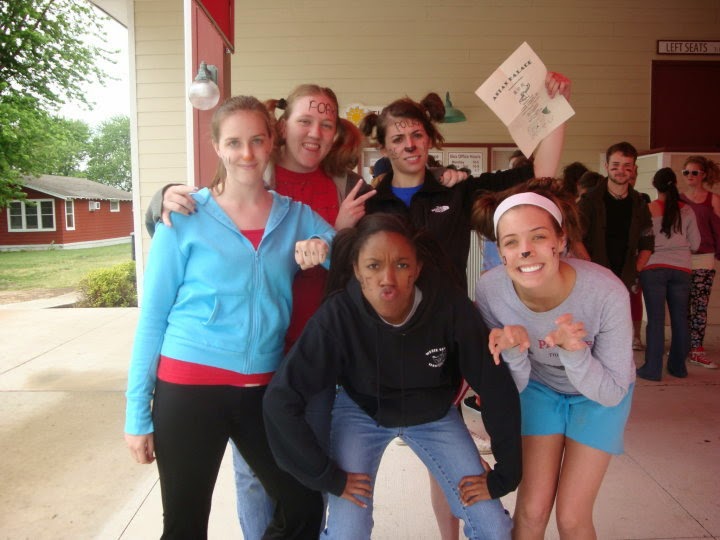


This is so important. Women's colleges matter. Today, as much as throughout history, women's colleges matter.
Sweet Briar College is closing their doors.
Why is this important? Who cares? There are thousands of colleges and universities in America; what does one less mean?
Sweet Briar College is one of the few women's colleges left in the country. Wikipedia (forgive me for quoting wikipedia, but it was difficult to find a list) states there are approximately 48 women's colleges still functioning as women's only institutions of higher education. Other articles say there were as many as 230 in the last 50 years. Sweet Briar was founded in 1901, and has been challenging, accepting, and encouraging young women ever since. It has made many top ten lists. They are a small liberal arts school in Virginia with only 760 students enrolled in this academic year and every one of them is a woman who will lose a home.
This is important to me because I attended a women's college. I did, and so did hundreds of thousands of other women throughout history. At one time, of course, they were the only way for women to attend college. What's more, for every woman in America and beyond that is looking at colleges, I want women's college to be an option for them all.
I chose to attend Stephens College after a rigorous and thorough search across the country of the best fit for my formative young adult independent years. I never intended to go to a women's college. I had an older brother, and grew up playing with mostly boys. I had as many boy friends as girl friends, and I'd never considered the idea that I'd ever knowingly choose to spend a significant period of time away from my male counterparts.
I'd also never considered the lack of equality in my life, how hard I fought for success in comparison to men, or what it was to appreciate women and being a woman through the eyes of women only.
I worked exceptionally hard through high school, knowing that I wanted to leave my home state for college. I had a great GPA, a long list of extracurricular activities, and enough volunteer hours and awards to make almost any school I wanted look my way. This is true for many women. When I attended my state theatre festival and auditioned for over 50 schools I was surprised at how many showed an interest. But after a long day of meetings, and several weeks of visiting campuses and pouring over websites--there was only one place that felt like home. Stephens. It didn't hurt that their theatre program was ranked #2 in the country at the time.
I remember making excuses for the inevitable questions--Why are you going to a women's college? Why do those even exist anymore? There aren't any boys there? How will you find your husband? And of course--you're studying theatre?
I remember telling people that Stephens was ranked #2 in the country. That the class size was small and intimate. That I would get more one on one time with my professors. That they had accepted all my AP credits and I could skip a lot of required classes. That the campus was beautiful, and I could get to class within five minutes. I remember saying "Well there are boys in the theatre department, of course." They were considered apprentices and not students.
The worst part is looking back and realizing that I knew I was making excuses. I hadn't yet reconciled myself to attending a college of only female students. But what I didn't realize was that I already knew deep down that Stephens was perfect for me. A women's college was perfect for me.
I had immediately felt wanted, respected, encouraged, and admired when I stepped onto campus. I had also felt the pressure of living up to a new set of standards and ideals. Not the kind you normally get when going to college--wake yourself up for class, try not to gain the freshman fifteen, higher education means all nighters and big lectures--get used to it. Instead I learned, along with the rest of my class, how to communicate with women, how to empower each other, how to look out for each other without depending on men, what it meant to depend on myself, and how to look at the world as if everything was in my grasp.
Because when a woman attends a women's college--that world is her's for those years. Every opportunity presented is only presented to women. Every experience is only experienced by women. And every opinion is validated by women. By sisters. And when she graduates she never learns to let that go. Women who graduate from women's colleges have a statistically high chance of succeeding in their chosen fields. Why? Because no one taught them to fail. A man was never given a position above them, and never took an opportunity from them. They have learned to believe in themself first and foremost. They have been taught that their opinion is important. And they have spent a significant amount of time in positions of power on their campus, giving them more experience than many women who attend co-educational institutions, and equal experience to many men.
Women's college taught me more about myself than I ever knew before--and most of it I didn't realize until after I graduated and was reintroduced to co-educational society. I spoke more confidently, I knew my goals and ideals, I made plans for my own personal happiness in my future. I interacted differently with romantic partners. I was more assertive about my expectations, and could more easily see and feel things that made me uncomfortable. I learned, in a way I had never fully understood before, the different ways that many women allow themselves to be put down. And more importantly, I felt I knew how to communicate compassionately and effectively with them and teach them what I had learned.
Women's college did make me a feminist. A word I had never associated with before. And a word that means and has always meant the theory of the political, economic, and social equality of the sexes. I shied away from it for a few years until I realized that doing so was going backwards on everything my education taught me about how to be a strong, independent, brave, bold, thoughtful, passionate, and deserving woman.
And all of this is to say that Sweet Briar College closing is a sad and unfortunate event. It is not just women's colleges that are struggling at this time, in this economy. It is the small private institutions all over. But the reason that this closing is of such tantamount importance is that it takes away one more option from women who might never know how positive an experience attending such a school can be. These young women who will be unable to finish their degrees at this institution will be looking for a new home. I hope every one of them finds as good a fit as the first one they found. And I encourage them all to look at Stephens College, and any other women's college out there.
A women's education was the best education I could have given myself. Every excuse I made to people was true, and those were reasons I attended. But I took away even more reasons to encourage other young women to attend. Every woman having to leave Sweet Briar, I'm certain, has a similar story. They are leaving behind their sisters and their family. But they are stronger than many, and are prepared to make bold choices.
Saturday, January 24, 2015
Horse Girls and girls and girls and girls
I returned from my summer in the south reluctantly, but excited to start the projects I had signed on for. I submitted myself for the UPTAs in September. I started making my plans for the regional theatre movement I was attempting to start for myself.
 The day after I got back, I had a photo shoot for promotional photos for the show. The reason I agreed to Horse Girls was not only the incredibly fun and challenging new script I had read, but because for the first time since college I was going to do an all women show! An ensemble based script, I was playing the lead Ashleigh, who was a preteen award winning equestrian. The director was a friend who had previously asked me to do a reading of the script a year before that I'd had to miss. Now, all these women were coming together to produce great work--at the perfect time. The subject matter starts fluffy but quickly turns dark. We ended up opening the show the week after a terrible school shooting in Marysville, WA. Because of this event, our opening night was poignant, tragic, and very real.
 We drove out of Seattle to a ranch that had offered us their horses and land to take some pictures. We hadn't rehearsed and we didn't know each other (as is often the case with these things) and got to bond over an afternoon of horses and girl talk. I couldn't wait for the next two months with these ladies.
As Development Director at Annex Theatre (who was producing this show as part of their season) I was a staff member, and company member, and now a cast member. Another of the cast members was also playing my sister Lydia in Pride and Prejudice, and before we opened Horse Girls we were already spending our days rehearsing for P&P.
I also had the pleasure for the first time since moving to Seattle to act with another Stephens College alum on stage. We were delighted to be working together after our time in college and it really brought us back to our roots in creating plays by, for, and about women.


The rehearsal process was challenging and exciting. We were working with a new script, a young director, and a great team. It was an incredibly physical show, not only in the sense of stage combat, but also the idea of putting yourself back into your preteen body and working so hard to be 'grown up'. We sang, we danced, we yelled, we cried, and we told our story.
In the end the New York based writer flew into Seattle to help us tech the show, and we opened to sold out audiences. The run of Horse Girls sold better than any other off-night show in Annex history. With an all women cast! I've attached the reviews below if you'd like to peruse them.
Seattle Times
Drama in the Hood
The Stranger
I had the thought during the run of the show that not often does it happen that I'll get to spend two contracts in a row working with mostly female casts! It was a joy, a gift, and a reminder of how I started and where I came from at Stephens College. I was inspired in those weeks to continue to do all I could to work with as many women in this field as I possible.
Shortly after we opened, a New York premiere of the show was announced, with another Stephens Woman in the cast! The end of our run at Annex was sad, but we were all moving onto different shows and knew that we'd work together again.
I can say this show was one of the most rewarding experiences I've had in my professional career.
The day after I got back, I had a photo shoot for promotional photos for the show. The reason I agreed to Horse Girls was not only the incredibly fun and challenging new script I had read, but because for the first time since college I was going to do an all women show! An ensemble based script, I was playing the lead Ashleigh, who was a preteen award winning equestrian. The director was a friend who had previously asked me to do a reading of the script a year before that I'd had to miss. Now, all these women were coming together to produce great work--at the perfect time. The subject matter starts fluffy but quickly turns dark. We ended up opening the show the week after a terrible school shooting in Marysville, WA. Because of this event, our opening night was poignant, tragic, and very real. We drove out of Seattle to a ranch that had offered us their horses and land to take some pictures. We hadn't rehearsed and we didn't know each other (as is often the case with these things) and got to bond over an afternoon of horses and girl talk. I couldn't wait for the next two months with these ladies.As Development Director at Annex Theatre (who was producing this show as part of their season) I was a staff member, and company member, and now a cast member. Another of the cast members was also playing my sister Lydia in Pride and Prejudice, and before we opened Horse Girls we were already spending our days rehearsing for P&P.
I also had the pleasure for the first time since moving to Seattle to act with another Stephens College alum on stage. We were delighted to be working together after our time in college and it really brought us back to our roots in creating plays by, for, and about women.
The rehearsal process was challenging and exciting. We were working with a new script, a young director, and a great team. It was an incredibly physical show, not only in the sense of stage combat, but also the idea of putting yourself back into your preteen body and working so hard to be 'grown up'. We sang, we danced, we yelled, we cried, and we told our story.
In the end the New York based writer flew into Seattle to help us tech the show, and we opened to sold out audiences. The run of Horse Girls sold better than any other off-night show in Annex history. With an all women cast! I've attached the reviews below if you'd like to peruse them.
Seattle Times
Drama in the Hood
The Stranger
I had the thought during the run of the show that not often does it happen that I'll get to spend two contracts in a row working with mostly female casts! It was a joy, a gift, and a reminder of how I started and where I came from at Stephens College. I was inspired in those weeks to continue to do all I could to work with as many women in this field as I possible.
Shortly after we opened, a New York premiere of the show was announced, with another Stephens Woman in the cast! The end of our run at Annex was sad, but we were all moving onto different shows and knew that we'd work together again.
I can say this show was one of the most rewarding experiences I've had in my professional career.
Monday, June 16, 2014
The Kilroys List 2014
Big news today from the New York Times about supporting women in theatre. Women playwrights to be exact. And with plays written by women comes more roles for women. Now that this list will be an annual occurrence, we can all rest easy knowing there's a central location to find great work by, for, and about women in the country. And then, you know, PRODUCE IT.
I had a long talk today about the way of the world of theatre outside Seattle, and it really got my brain churning on the things I've been becoming complacent about. One of those things is just the act of starting a conversation. To have a dialogue with professionals and peers about our theatre culture and where we want to take it.
I have these discussions, but not as often as I should, and certainly not for as long as I should. I'm missing a challenge and a dream, and I'm going to spend my summer finding where it's at.
Subscribe to:
Posts (Atom)